Introduction
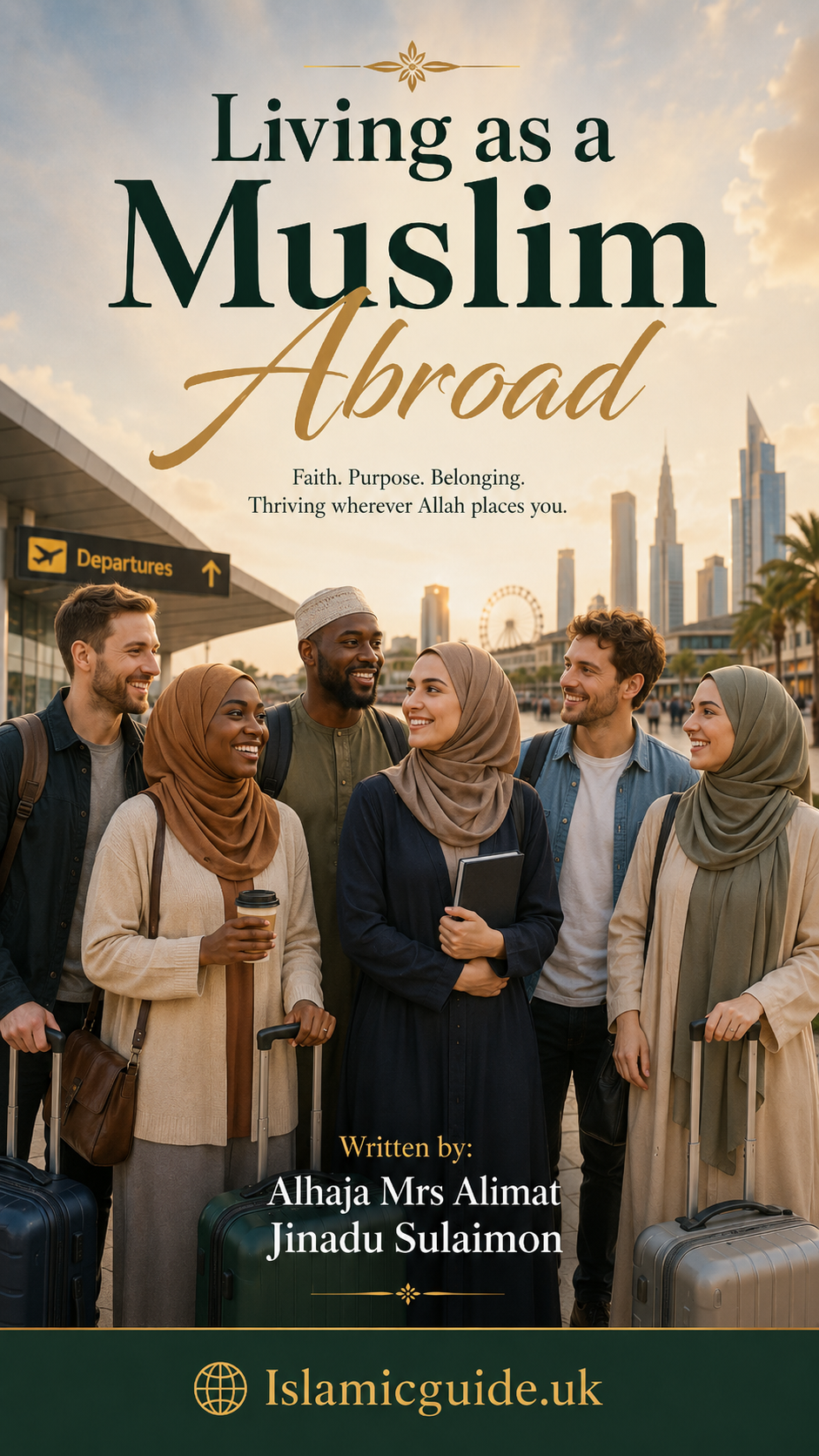
Living as a Muslim Abroad
Living as a Muslim abroad is a journey of faith, identity, patience, and purpose. For many Muslims, moving to another country brings new opportunities, new friendships, new education, new work, and new experiences. Yet, it can also bring challenges: being far from family, adjusting to a different culture, finding halal food, maintaining salah, wearing Islamic clothing with confidence, raising children with Islamic values, and staying connected to Allah in an environment that may not always remind us of Him.
This book has been written to guide, encourage, and strengthen Muslims who are living away from their homeland. Whether you are a student, a worker, a parent, a new migrant, or someone who has lived abroad for many years, this book is for you. It is a reminder that Islam is not limited to one country, one language, or one culture. Islam is a complete way of life that can be practiced with dignity wherever Allah places us.
Living abroad does not mean losing your Muslim identity. Rather, it can become a powerful opportunity to show the beauty of Islam through good character, honesty, kindness, modesty, patience, and respect for others. The Prophet Muhammad (saw) taught us the importance of excellent manners, and every Muslim carries that responsibility wherever they go. In a foreign land, your behavior may become someone’s first introduction to Islam.
This book will discuss practical issues that Muslims face abroad, including faith, worship, identity, family life, education, community, halal living, modesty, confidence, and dealing with loneliness or cultural pressure. It will also remind us that our real success is not only in settling well in this world, but in remaining close to Allah and preparing for the Hereafter.
The Qur’an reminds us that Allah created people into nations and tribes so that they may know one another, not despise one another. Therefore, living among different people should not weaken our faith; it should teach us wisdom, patience, and understanding. A Muslim can be respectful to society while still holding firmly to Islamic values.
May this book be a source of comfort, guidance, and motivation for every Muslim living abroad. May Allah make it beneficial for young people, adults, families, students, and communities. May He keep our hearts firm upon Islam, bless our efforts, protect our families, and allow us to represent our religion with beauty, confidence, and sincerity.
Chapter One
Holding Firm to Your Muslim Identity
Living as a Muslim abroad begins with one important question: Who am I when the environment around me is different from what I know?
For many Muslims, moving abroad can feel exciting at first. There may be better education, job opportunities, safety, business possibilities, and a chance to experience a new way of life. But after some time, the reality becomes deeper. You begin to notice that the language is different, the culture is different, the dressing is different, the food is different, and sometimes even the daily rhythm of life does not naturally support your Islamic routine.
In some places, you may not hear the adhan. You may not see many people going to the masjid. You may find yourself praying in a quiet corner at work, school, university, or even in a public space. You may be the only sister wearing hijab in a room, or the only brother trying to avoid certain gatherings. You may be asked questions about your faith, your modesty, your fasting, your salah, or why you choose not to follow certain social habits.
This is where Muslim identity becomes important.
Your identity is not only your name, your passport, your language, your clothing, or the country you come from. Your deepest identity is that you are a servant of Allah. You belong to Allah before you belong to any land. You are Muslim before you are anything else. This does not mean you cannot respect other cultures or live peacefully with people from different backgrounds. Islam teaches respect, kindness, fairness, and good manners. But it means that your values must remain rooted in faith.
Allah says in the Qur’an:
"Indeed, this religion of yours is only one, and I am your Lord, so worship Me alone.
"Surah Al-Anbiya 21:92
This verse reminds us that Muslims are connected by something greater than race, nationality, tribe, or location. Whether you are in Nigeria, Britain, America, Canada, Saudi Arabia, Turkey, Malaysia, or any other country, your connection to Allah remains the same. The land may change, but the Lord you worship does not change. The society may change, but the command of Allah does not change. The people around you may live differently, but your path as a Muslim remains guided by the Qur’an and the Sunnah.
However, holding firm to your Muslim identity abroad does not mean being harsh, isolated, or judgmental. A Muslim should not live with fear of others, nor should a Muslim look down on people. Instead, a Muslim abroad should live with confidence, wisdom, and beautiful character. People should see honesty in your dealings, patience in your speech, modesty in your appearance, respect in your behavior, and sincerity in your worship.
Sometimes, the greatest da’wah is not a long lecture. It is how you treat your neighbors. It is how you speak to your classmates. It is how you work with integrity. It is how you remain calm when others misunderstand you. It is how you carry your Islam with peace, not shame.
The Prophet Muhammad (saw) said:
“The best of you are those who are best in character.”
Sahih al-Bukhari
This hadith is especially powerful for Muslims living abroad. In a place where people may not know much about Islam, your character can become a living example. Your kindness can correct a wrong image. Your honesty can open hearts. Your modesty can show dignity. Your patience can show strength. Your smile can become a form of da’wah.
But we must also be honest: living abroad can test the heart.
There may be pressure to fit in. There may be pressure to dress differently, speak differently, behave differently, or slowly leave some Islamic practices behind. At first, a person may only miss one prayer. Then it becomes normal. A person may first feel shy about Islamic clothing. Then they begin to remove parts of their identity to feel accepted. A person may first avoid haram gatherings. Then they begin to attend, telling themselves, “I am only watching.” This is why self-awareness is important.
A Muslim must ask: Am I adapting to survive, or am I changing in a way that weakens my faith?
There is a difference between learning a new culture and losing yourself inside it. Islam does not stop us from learning languages, studying, working, building careers, respecting laws, or living peacefully in society. In fact, Muslims should be responsible and beneficial wherever they live. But Islam teaches us to take what is good and leave what is harmful.
- You can live abroad and still pray on time.
- You can study abroad and still dress modestly.
- You can work abroad and still earn halal income.
- You can make friends abroad and still protect your values.
- You can respect people of other faiths and still be firm in your own.
- You can be modern without being careless.
- You can be confident without being arrogant.
- You can belong to society without forgetting that your final return is to Allah.
One of the most important ways to protect your Muslim identity abroad is to build a strong connection with Allah privately. Public confidence begins with private worship. If your heart is attached to Allah when no one is watching, it becomes easier to stand firm when everyone is watching.
Make salah your foundation. Do not treat prayer as something you fit into life only when convenient. Rather, build your life around salah. Salah gives structure to your day, peace to your mind, and protection to your heart. Even in a busy country, even in university, even at work, even while travelling, salah remains your spiritual anchor.
The Qur’an says:
"Recite, [O Muhammad], what has been revealed to you of the Book and establish prayer. Indeed, prayer prohibits immorality and wrongdoing, and the remembrance of Allah is greater. And Allah knows that which you do.
"Surah Al-Ankabut 29:45
This means prayer is not only a ritual. It is a protection. It reminds you who you are. It brings you back to Allah five times a day. When the world becomes noisy, salah brings the heart back to clarity.
Another way to protect your identity is to choose good company. Living abroad can become lonely, and loneliness can make a person vulnerable. A person may accept any friendship simply because they do not want to feel alone. But not every friendship strengthens the soul. Some people bring you closer to Allah, and some people slowly pull you away.
Good friends remind you to pray. They respect your boundaries. They do not mock your faith. They support your modesty. They make halal easier. They encourage your goals without weakening your religion. If you find such people, value them. If you do not find them immediately, be patient and ask Allah to guide you to righteous companionship.
At the same time, be kind to everyone. Islam does not teach rudeness or unnecessary separation from society. A Muslim can work with people, study with people, greet people, help people, and live respectfully among people. But the heart must know its limits. Kindness does not mean copying everything. Respect does not mean surrendering your principles.
Living as a Muslim abroad is not about hiding your faith. It is about carrying it with wisdom. It is not about being perfect. It is about returning to Allah every time you struggle. It is not about being accepted by everyone. It is about being sincere before Allah.
There may be days when you feel tired. There may be days when you feel different. There may be days when you wish practicing Islam was easier. But remember: every sincere effort is seen by Allah. Every prayer you protect, every temptation you avoid, every moment you choose faith over pressure, every time you remain patient when misunderstood — Allah knows it all.
Your life abroad can become a beautiful chapter of worship if you live it with intention. Your education can be worship if you seek beneficial knowledge. Your work can be worship if you earn halal and serve people honestly. Your parenting can be worship if you raise your children with faith. Your community service can be worship if you do it for Allah. Even your struggle can become worship when you remain patient and hopeful.
So do not see living abroad only as a worldly journey. See it as a spiritual responsibility. You are not just a traveler, student, worker, parent, or resident. You are a Muslim carrying the light of Islam wherever Allah has placed you.
- Hold firm to your identity.
- Be gentle, but do not be weak.
- Be open-minded, but do not be empty-hearted.
- Be respectful, but do not lose your values.
- Be confident, because Islam is an honor.
- And wherever you live, let your life quietly say:
I am Muslim, I belong to Allah, and I will live with faith, dignity, and purpose.
Reflection Questions
- What parts of my Muslim identity do I sometimes feel shy to show abroad?
- How can I make salah a stronger part of my daily routine?
- Who are the people around me that strengthen my faith?
- What habits do I need to protect myself from?
- How can my character represent Islam beautifully in my community?
Key Reminder
Living abroad may change your environment, but it should never remove your connection with Allah. Your Muslim identity is not a burden. It is an honor, a protection, and a light.
Chapter Two
Building a Life Around Salah and Faith
Living abroad can change many things in a person’s life. The language may change, the weather may change, the food may change, the people may change, and even the way each day is organised may feel completely different. But for a Muslim, one thing must never change: the connection with Allah.
When a Muslim lives in a new country, it is easy for life to become very busy. There may be school, university, work, family responsibilities, appointments, bills, transport, studies, business, and many other demands. In some countries, the system is fast, the days are full, and people are always moving from one responsibility to another. If a Muslim is not careful, faith can slowly be pushed to the side.
This is why salah must become the centre of a Muslim’s life abroad.
Salah is not only something we do when we have time. Salah is the foundation of our day. It is the meeting between the servant and Allah. It is the moment when the heart leaves the noise of the world and stands before the Creator. A Muslim may be far from their homeland, far from family, and far from familiar surroundings, but when they stand in prayer, they are never far from Allah.
Allah says in the Qur’an:
And when you have completed the prayer, remember Allah standing, sitting, or [lying] on your sides. But when you become secure, re-establish [regular] prayer. Indeed, prayer has been decreed upon the believers a decree of specified times."
“Surah An-Nisa 4:103’
This verse reminds us that salah has its own appointed time. It is not meant to be treated casually or delayed until everything else is finished. Abroad, this can be challenging because work, school, and society may not be built around prayer times. There may be no adhan to remind you. There may be no masjid nearby. People around you may not understand why you need to pray. But this is where discipline begins.
A Muslim living abroad must learn how to plan around salah. Check prayer times daily. Know where you can pray at work, in school, at university, or while travelling. Keep a small prayer mat if possible. Use your break wisely. If you need a private space, ask politely. Many people will respect your faith when you explain it with confidence and good manners.
Do not feel shy to pray. The earth belongs to Allah. Your body belongs to Allah. Your time belongs to Allah. The One you are standing before is greater than the opinion of people. When you pray in a new country, you are reminding yourself that your identity is not lost. You are still a servant of Allah wherever you are.
Living abroad also teaches the Muslim the importance of personal responsibility. In some places, Islamic practice is supported by the environment. Families wake each other for Fajr. Communities remind each other about Jumu’ah. Shops close around prayer. The adhan enters the heart five times a day. But abroad, you may need to become your own reminder.
This is not a weakness. It can actually strengthen you.
When you choose to pray without being pushed, your sincerity grows. When you wake for Fajr while the city is still asleep, your heart learns discipline. When you leave something haram even though nobody is watching, your taqwa becomes stronger. When you protect your faith in a place where it is not always easy, your relationship with Allah becomes more personal and meaningful.
Faith abroad must be built daily. It is not enough to say, “I am Muslim.” A Muslim identity must be nourished through worship, knowledge, remembrance, and good actions. Just as the body needs food, the heart needs iman. If the heart is not fed with Qur’an, salah, dhikr, and sincere worship, it becomes weak.
The Qur’an should have a place in the life of every Muslim abroad. Even if you read a small amount each day, keep that connection alive. Read after Fajr, before sleeping, during a quiet moment, or while reflecting after salah. If reading Arabic is difficult, listen to recitation and read the meaning in a language you understand. The Qur’an is not only for scholars. It is guidance for every believer.
Allah says:
“This is the Book about which there is no doubt, a guidance for those conscious of Allah.”
Surah Al-Baqarah 2:2
In a foreign land, the Qur’an becomes a guide when life feels confusing. It reminds you of your purpose when the world becomes distracting. It comforts you when loneliness enters your heart. It corrects you when you begin to drift. It strengthens you when you feel weak.
Another important part of building a life around faith is remembering Allah throughout the day. Dhikr is simple, but powerful. Saying SubhanAllah, Alhamdulillah, Allahu Akbar, La ilaha illa Allah, and Astaghfirullah keeps the heart alive. You can remember Allah while walking, cooking, travelling, cleaning, working, or resting. Dhikr turns ordinary moments into moments of worship.
A Muslim abroad should also be careful about routines. Your routine can either protect your faith or weaken it. What you do every morning, what you watch, who you speak to, where you go, how you spend your evenings, and what you allow into your mind will all affect your heart.
If your day begins with rushing and ends with distraction, your soul may become tired. But if your day begins with Fajr, includes remembrance of Allah, respects halal boundaries, and ends with gratitude, then even a busy life can become peaceful.
This does not mean life will always be easy. There will be days when you feel spiritually low. There will be days when you are tired, stressed, or emotionally weak. There may be times when you miss a prayer or make a mistake. But do not allow one mistake to become a permanent distance from Allah. Return quickly. Make tawbah. Ask Allah for strength. Begin again.
Allah is Most Merciful. He knows the struggle of every believer. He knows the Muslim student trying to pray between lectures. He knows the mother raising children in a society full of different values. He knows the worker trying to avoid haram income and protect salah. He knows the young Muslim trying to remain modest and confident. He knows the lonely heart that is still trying.
Never think your effort is small in the sight of Allah.
The Prophet Muhammad (saw) said:
“The most beloved deeds to Allah are those that are consistent, even if they are few.”
Sahih al-Bukhari and Sahih Muslim
This hadith gives hope. You do not need to do everything at once. Start with what you can maintain. Pray on time. Read a little Qur’an daily. Make dhikr. Avoid one bad habit. Attend one Islamic class. Improve one part of your character. Then continue. Small actions done sincerely and consistently can transform a life.
For Muslims abroad, the home must also become a place of faith. Even if the outside world is busy and distracting, the home can be filled with Islamic reminders. Pray together when possible. Play Qur’an recitation. Teach children simple duas. Speak about Allah with love. Make Islamic books available. Celebrate Islamic occasions with meaning. Let the home remind everyone that Islam is not only something we practice outside; it is the heart of our private life.
Parents living abroad have an important responsibility. Children may grow up seeing many different lifestyles and beliefs. They may ask questions. They may compare themselves with others. They may wonder why Muslims pray, fast, dress modestly, avoid certain foods, or live with boundaries. Instead of only giving rules, parents should give understanding. Teach Islam with love, wisdom, and patience. Let children feel that Islam is not a burden, but a blessing.
Adults also need reminders. Sometimes people think Islamic learning is only for children, but every Muslim needs knowledge. Attend classes when possible. Listen to beneficial lectures. Ask trusted scholars when confused. Read authentic books. Learn the basics of worship properly. The more you understand Islam, the more confidently you can practice it abroad.
Building a life around faith does not mean rejecting the country you live in. Islam teaches Muslims to be respectful, responsible, and beneficial members of society. A Muslim abroad should obey the law, treat neighbors kindly, work honestly, study seriously, and contribute positively. But while doing all of this, the Muslim must never forget the higher purpose of life.
We are not created only to earn, study, travel, marry, build businesses, or settle comfortably. These things may be part of life, but they are not the final purpose. Our final purpose is to worship Allah and return to Him with a sound heart.
Living abroad can become a beautiful journey when salah and faith are placed at the centre. Your new country can become a place where you grow stronger. Your challenges can become lessons. Your loneliness can bring you closer to Allah. Your discipline can increase your iman. Your good character can become da’wah. Your home can become a small garden of faith.
So build your life around Allah before building it around anything else.
- Let salah shape your day.
- Let Qur’an guide your thoughts.
- Let dhikr soften your heart.
- Let halal choices protect your soul.
- Let good character represent your Islam.
- Let your home remind you of the Hereafter.
Wherever you live, do not allow the world to become bigger in your heart than Allah. A Muslim abroad is not lost when they remain connected to their Lord. The road may be unfamiliar, but the direction is clear.
Your home is where Allah is remembered.
Your strength is in salah.
Your honor is in Islam.
Your success is in staying close to Allah.
Reflection Questions
1. Do I plan my day around salah, or do I fit salah around my day?
2. What can I do to make prayer easier at work, school, or university?
3. How often do I connect with the Qur’an during the week?
4. What daily habits are helping or harming my iman?
5. How can I make my home feel more connected to Islam?
Key Reminder
A Muslim living abroad must not allow a busy life to weaken their connection with Allah. When salah becomes the center of your day, faith becomes the center of your life.
Chapter Three
Knowing Who You Are: Islam Before Culture
One of the greatest tests for a Muslim living abroad is learning how to live among different people without losing the truth of Islam. Abroad, a Muslim may meet many cultures, traditions, habits, lifestyles, and ways of thinking. Some of them may be good, respectful, and beneficial. Some may be neutral and harmless. But some may go against what Allah has commanded.
This is why every Muslim must understand one important truth: Islam comes before culture.
Culture can be beautiful. It can give people language, food, clothing, family customs, hospitality, manners, and a sense of belonging. Every nation has its own way of life, and Islam does not reject everything from culture. In fact, Islam allows what is good, modest, fair, and beneficial, as long as it does not go against the Qur’an and the Sunnah.
But culture must never become stronger than Islam in the heart of a believer.
A Muslim is not guided by what people say is normal. A Muslim is guided by what Allah says is right. A Muslim does not follow every trend simply because society accepts it. A Muslim does not join every gathering simply because friends invite them. A Muslim does not copy every lifestyle simply because it looks modern, popular, or attractive. The believer must always ask: Is this pleasing to Allah?
When a Muslim lives abroad, this question becomes very important.
There may be situations where haram is presented as normal. Alcohol may be common at work events, parties, restaurants, celebrations, and social gatherings. Free mixing without boundaries may be treated as ordinary. Immodesty may be seen as confidence. Haram relationships may be described as freedom. Interest-based dealings may be considered part of financial life. Gossip, backbiting, and inappropriate entertainment may become part of daily conversations.
If a Muslim is not careful, the heart can slowly become comfortable with what Allah has forbidden.
At first, a person may feel uncomfortable around haram. Then, after seeing it repeatedly, they may begin to feel it is not serious. Later, they may start participating in it. This is why Islam teaches us to protect not only our actions, but also our surroundings, habits, friendships, and thoughts.
Allah says in the Qur’an:
“O mankind, eat from whatever is on earth [that is] lawful and good and do not follow the footsteps of Satan. Indeed, he is to you a clear enemy.”
Surah Al-Baqarah 2:168
This verse is a powerful reminder because Shaytan does not always lead people to sin suddenly. Sometimes he leads people step by step. One small compromise becomes another. One missed prayer becomes easier to repeat. One haram gathering becomes a regular habit. One wrong friendship begins to change a person’s values. One excuse becomes a lifestyle.
A Muslim abroad must be awake spiritually.
Living abroad does not mean you should isolate yourself from everyone. Islam does not teach hatred, rudeness, or unnecessary separation from society. Muslims should be kind, respectful, helpful, peaceful, and responsible wherever they live. We should treat neighbors well, speak with good manners, work honestly, study seriously, and contribute positively to the community.
• But being kind does not mean joining haram.
• Being respectful does not mean losing boundaries.
• Being friendly does not mean copying everything.
• Being modern does not mean forgetting Allah.
• Being abroad does not mean Islam becomes less important.
A Muslim can greet people warmly without attending sinful gatherings. A Muslim can work professionally without compromising prayer. A Muslim can study with different people without losing modesty. A Muslim can respect other cultures without making them a replacement for Islam. A Muslim can live peacefully in society while still obeying Allah.
This balance is important.
Some Muslims become too relaxed when they live abroad. They begin to say, “This is how people live here.” They may feel embarrassed to practice Islam openly. They may remove Islamic values from their daily life because they want to fit in. Over time, they may begin to treat Islam as something only for Ramadan, Eid, marriage ceremonies, funerals, or family occasions.
But Islam is not a seasonal identity. Islam is not only for the masjid. Islam is not only for elders. Islam is not only for the country we came from. Islam is a complete way of life.
Allah says:
"O you who have believed, enter into Islam completely [and perfectly] and do not follow the footsteps of Satan. Indeed, he is to you a clear enemy."
Surah Al-Baqarah 2:208
This means a Muslim should not choose only the parts of Islam that feel easy and ignore the parts that require discipline. We cannot take Islam only when it suits our culture, our comfort, or our desires. The command of Allah is guidance for every part of life: worship, family, business, manners, clothing, relationships, speech, food, money, and character.
However, we must also understand Islam correctly. Practicing Islam should not make a person live in constant stress, fear, or confusion. Allah did not reveal Islam to destroy our peace. He revealed Islam to guide us, protect us, purify us, and bring us closer to Him.
Sometimes, Muslims abroad may feel overwhelmed. They may ask themselves: How can I pray at work? How can I raise my children Islamically? How can I avoid haram when it is everywhere? How can I dress modestly and still feel confident? How can I answer people’s questions? How can I remain Muslim without feeling lonely?
This balance is important.
Some Muslims become too relaxed when they live abroad. They begin to say, “This is how people live here.” They may feel embarrassed to practice Islam openly. They may remove Islamic values from their daily life because they want to fit in. Over time, they may begin to treat Islam as something only for Ramadan, Eid, marriage ceremonies, funerals, or family occasions.
But Islam is not a seasonal identity. Islam is not only for the masjid. Islam is not only for elders. Islam is not only for the country we came from. Islam is a complete way of life.
Allah says:
"O you who have believed, enter into Islam completely [and perfectly] and do not follow the footsteps of Satan. Indeed, he is to you a clear enemy."
Surah Al-Baqarah 2:208
This means a Muslim should not choose only the parts of Islam that feel easy and ignore the parts that require discipline. We cannot take Islam only when it suits our culture, our comfort, or our desires. The command of Allah is guidance for every part of life: worship, family, business, manners, clothing, relationships, speech, food, money, and character.
However, we must also understand Islam correctly. Practicing Islam should not make a person live in constant stress, fear, or confusion. Alplah did not reveal Islam to destroy our peace. He revealed Islam to guide us, protect us, purify us, and bring us closer to Him.
Sometimes, Muslims abroad may feel overwhelmed. They may ask themselves: How can I pray at work? How can I raise my children Islamically? How can I avoid haram when it is everywhere? How can I dress modestly and still feel confident? How can I answer people’s questions? How can I remain Muslim without feeling lonely?
- Not everything our families do is Islam.
- Not everything our culture teaches is Islam.
- Not everything abroad offers is wrong.
- Not everything abroad offers is right.
A Muslim must learn the difference.
For example, respecting elders is good and encouraged in Islam. Hospitality is good. Modest dressing is good. Family support is good. But if a culture encourages oppression, arrogance, tribalism, extravagance, forced decisions, or looking down on others, then that part of culture must not be defended in the name of Islam.
In the same way, some practices abroad may be good, such as punctuality, organisation, respect for public space, education, professionalism, cleanliness, and fairness. A Muslim can learn from these good qualities. But if the culture promotes haram relationships, alcohol, immodesty, selfishness, disrespect to parents, or forgetting Allah, then the Muslim must not copy those parts.
Islam is the standard.
The Muslim abroad should not ask, “What will people think?” before asking, “What does Allah want from me?” People’s opinions change. Society’s values change. Fashion changes. Trends change. Laws and lifestyles may change. But the guidance of Allah remains true.
When Islam becomes the standard, life becomes clearer. You will know when to say yes and when to say no. You will know which friendships are safe and which ones are harmful. You will know which opportunities are halal and which ones must be avoided. You will know how to respect people without following them blindly.
This clarity gives peace.
Many people think freedom means doing whatever the soul desires. But in Islam, true freedom is not being controlled by desire, pressure, people, or trends. True freedom is worshipping Allah alone. When your heart belongs to Allah, you are not easily controlled by society. You do not need everyone’s approval to feel valuable. You do not need to follow haram to feel included. You do not need to hide your faith to feel accepted.
Your honor is in Islam.
Allah says:
“Then when they have almost reached the end of their waiting period, either retain them honorably or separate from them honorably. And call two of your reliable men to witness either way and let the witnesses bear true testimony for the sake of Allah. This is enjoined on whoever has faith in Allah and the Last Day. And whoever is mindful of Allah, He will make a way out for them”
Surah At-Talaq 65:2
This is a promise from Allah. Sometimes avoiding haram may feel difficult. You may worry about losing friends, opportunities, comfort, or acceptance. But when you leave something for Allah, He can replace it with something better. He can open doors you never expected. He can give you peace that people cannot give. He can put respect for you in the hearts of others.
There will be moments when you have to stand alone. You may be the only person not drinking. The only person leaving to pray. The only person dressed modestly. The only person saying no to a relationship. The only person avoiding gossip. The only person refusing dishonest money.
Do not be ashamed.
Standing alone for Allah is better than being surrounded by people while losing yourself. The believer’s strength is not in how many people approve of them. The believer’s strength is in obedience to Allah.
Living abroad can be a test, but it can also be a blessing. It can teach you to practise Islam with intention, not only habit. It can help you separate true Islam from culture. It can strengthen your confidence. It can make you appreciate the value of salah, halal living, modesty, Islamic knowledge, and good companionship.
When you know who you are, you do not need to copy everything around you.
- You are a Muslim.
- You belong to Allah.
- Your guidance is the Qur’an.
- Your example is the Prophet Muhammad(saw).
- Your value is not measured by people’s approval.
- Your success is not in blending into every culture.
- Your success is in obeying Allah with sincerity, wisdom, and peace.
So live abroad with an open mind, but not an empty heart. Respect people, but do not worship their lifestyle. Learn from society, but do not lose your Islam. Be kind, but keep your boundaries. Be confident, but remain humble. Practise your religion, but do not make it a source of unnecessary stress.
Allah has not asked you to be perfect. He has asked you to strive, repent, learn, obey, and keep returning to Him.
Wherever you are in the world, remember this clearly: culture may shape your surroundings, but Islam must shape your soul.
Reflection Questions
1. Do I sometimes follow culture more than Islam?
2. What haram environments or habits do I need to avoid more seriously?
3. How can I respect people abroad without copying what goes against Islam?
4. What cultural practices do I need to separate from true Islamic teachings?
5. How can I practice Islam with balance, confidence, and peace?
Key Reminder
A Muslim abroad should respect different cultures, but Islam must always come first. Do not allow society, pressure, or fear of people to replace the guidance of Allah. Practise your faith with wisdom, avoid haram with confidence, and remember that Allah’s commands are protection, not hardship.
Conclusion
Living as a Muslim abroad is a journey that requires faith, patience, wisdom, and strong identity. A Muslim may live among different cultures, languages, and lifestyles, but Islam must remain the foundation of the heart. Wherever we are, we must remember Allah, protect our salah, avoid what is haram, seek halal living, and represent Islam through good character.
Living abroad should not make us lose ourselves. Instead, it should strengthen our connection with Allah and teach us how to practice Islam with confidence and balance. We can respect people, learn from good cultures, and contribute positively to society, while still holding firmly to the Qur’an and the Sunnah.
Islam is not a burden; it is guidance, mercy, and protection. May Allah keep every Muslim firm, peaceful, and sincere wherever they live, and may He make our lives abroad a means of goodness in this world and the Hereafter.